Thursday, 2 October 2014

Making pounded yams with Maman Christian / Faire de la purée d'ignorer avec Maman Christian

Step 1: Peel the yams


Step 2: Quentin gives Etienne 'the force' by telepathy ;-)


Step 3: Put the various brightly-coloured ingredients in as many pots as possible


Step 4: Fry the tofu (a cheap alternative to the much tastier wagashi cheese)


Step 5: Grind garlic cloves and peanut butter to make a paste for the sauce


Step 6: Stir the spicy tomato sauce


Step 7: Work in pairs to pound the yams until they become a bit elastic


Step 8: Dinner time!!

***************************************************************************

1. Eplucher les ignames

2. Quentin transmet sa force à Etienne par télépathie


3. Mettre les différents ingrédients colorés dans autant de bols ou d’assiettes que possible

4. Faire frire le tofu (une alternative bon marché au fromage wagashi, bien plus goûteux)

5. Ecraser les gousses d’ail et les mélanger au beurre de cacahouète pour en faire une pâte pour la sauce

6. Mélanger la sauce tomate épicée

7. Travailler à deux pour écraser les ignames jusqu’à ce qu’ils deviennent un peu élastiques,

8. Il est temps de manger

Wednesday, 1 October 2014

Wedding invitation / Invitation au mariage

Before Quentin left, he introduced us to one of his friends, Ibram. Ibram is a Muslim guy, around our age, who lives down the road from us and is keen to practise speaking English as often as he can! He treated us to a meal at a local restaurant a few weeks ago and we enjoyed talking with him about his girlfriend, his plans for the future, his celebrity status as a local music artist, his faith and our faith. As we walked back from the restaurant, he proudly introduced us to many of his friends who were sitting around in the streets. We’ve bumped into him several times since that meal and we are always happy to see his very smiley face! We were still surprised to receive a phone call from him one Saturday evening, inviting us to attend his friends’ wedding receptions the following day (there were three of them!). We gratefully accepted! The next morning, we donned our smartest African clothes, met Ibram at his house and then walked together to the first reception. A whole street corner had been taken over by white plastic chairs, and lots of adults were sitting there watching the world go by. Someone came by and handed us some little plastic bottles of Coke. A bunch of children immediately swarmed around us, asking for the bottles when we had finished. Ibram then went to the kitchen area to ask for some food for us but when he learned it wouldn’t be ready for a while, he decided it was time to go to the second wedding! After a 10 minute walk, we turned a corner and were confronted by extremely loud music blaring from two large speakers on the side of the dusty road. A giant tarpaulin had been strung between electricity poles on both sides of the road to provide shade for the all the children sitting on the many white plastic chairs which filled, and blocked, the road. Ibram dismissed a few children and invited us to sit with him. A few moments later, the groom appeared and joined us too. He then disappeared in search of food for us, and returned with brightly-coloured plastic bowls filled with unidentifiable orange mush. We prayed that we wouldn’t get sick and began to eat. It tasted surprisingly good but I didn’t manage to finish mine, and following Ibram’s lead, put the bowl down beside my chair. Immediately, some children flew at the bowl and desperately devoured what was left! A very short while later, the groom disappeared again and came back with more plastic bowls, this time filled with spaghetti. We were so full already but couldn’t refuse his generosity. We ate what we could and then put the bowls on the floor again, where once more they were hastily grabbed! What we found out later was that these children weren’t guests of the wedding party – they just gate-crashed, hoping to get some food, drink or empty bottles! Later on in the day, the groom took us to see his new home, which consisted of a simple living room with four chair frames (no cushions), a coffee table and a TV, and a bedroom. Outside the home were all the wedding gifts: a plethora of pots and pans, several packs of brightly coloured fabrics, cleaning equipment and more kitchen bits. I’m not sure there was room in the house for everything but I guess they will make it fit in somehow! Before Ibram could take us to the third wedding, we received a phone call from the pastor asking for help, so we bid Ibram and the groom farewell and made our way to the pastor’s home. What a relief it was to be far from the blaring speakers – we’re such old people!!

******************************************************************

Avant que Quentin ne nous quitte, il nous a mis en contact avec l’un de ses amis, Ibram. C’est  un musulman de nos âges environ, qui habite au bas de notre rue et qui aspire à parler anglais aussi souvent qu’il le peut. Il nous a offert un repas dans un restaurant du coin il y a quelques semaines et nous nous sommes réjouis de pouvoir parler avec lui de sa fiancée, de ses projets pour l’avenir, de son statut de célébrité locale en tant que chanteur, de sa foi et de la nôtre. Alors que nous revenions du restaurant,  il nous a fièrement présentés à nombre de ses amis, assis dans la rue. Depuis ce repas, nous nous sommes fortuitement revus à plusieurs occasions, et nous sommes toujours heureux de voir son visage  souriant. Nous sommes encore surpris du coup de fil de sa part reçu un samedi soir nous invitant à la réception du mariage d’un de ses amis pour le lendemain. (En fait, il y en aura trois). Nous avons accepté avec joie.
Le lendemain matin, revêtus de nos plus beaux vêtements africains, nous avons retrouvé Ibram chez lui puis nous sommes rendus avec lui à la première réception. Des chaises en plastique blanc occupaient une large portion de la rue et de nombreux adultes assis regardaient « passer la vie ». Quelqu’un nous a donné des petites bouteilles en plastique de coca-cola.  Immédiatement une nuée d’enfants nous a entourés pour nous demander de leur donner ces bouteilles lorsque nous les aurions bues. Ibram est allé ensuite vers l’espace cuisine pour demander qu’on nous apporte à manger, mais quand il a appris que le repas ne serait pas prêt avant un certain temps, il a décidé qu’il était temps d’aller au second mariage. Après 10 mn de marche nous avons tourné au coin de la rue et avons été confrontés à une musique très bruyante provenant des deux haut-parleurs placés de chaque côté d’une rue poussiéreuse. Une immense bâche était tendue entre les poteaux électriques de part et d’autre de la rue pour faire de l’ombre aux enfants assis sur les nombreuses chaises en plastique blanc qui remplissaient et bloquaient la rue. Après avoir fait partir des enfants, Ibram nous a invités à nous asseoir avec lui. Quelques instants plus tard, le fiancé nous a rejoints puis a disparu pour chercher de la nourriture et est revenu avec des bols en plastique colorés remplis d’une bouillie orange non identifiable. Nous avons prié en espérant ne pas tomber malades et avons commencé à manger. De facon surprenante, c’était assez bon, mais je n’ai pu finir mon bol, et sur le conseil d’Ibram j’ai posé mon bol par terre à coté de ma chaise. Immédiatement des enfants se sont précipités dessus et ont dévoré ce qui restait. Quelques minutes plus tard le fiancé disparut à nouveau et revint avec d’autres bols en plastique remplis de spaghetti. Bien que déjà repus, nous ne pouvions faire offense à sa générosité. Nous avons mangé ce que nous avons pu, et déposé nos bols à terre. Une fois de plus les enfants s’en sont rapidement saisis. Nous avons compris plus tard  que ces enfants n’étaient pas invités au mariage. Ils s’étaient introduits avec l’espoir de récupérer de la nourriture, une boisson ou une bouteille vide. Plus tard dans la journée le fiancé nous a montré sa nouvelle demeure, un simple salon avec quatre châssis de fauteuils sans coussins, une table basse,  une TV et une chambre à coucher. A l’extérieur de la maison il y avait tous les cadeaux de mariage ; de nombreuses casseroles et poêles à frire, des lots de tissus aux couleurs vives, des kits de nettoyage et d’autres ustensiles de cuisine. Je ne suis pas certaine qu’il y ait de la place pour tout cela dans la maison, mais je suppose qu’ils y arriveront ! Avant qu’Ibram puisse nous conduire vers le troisième mariage, un coup de fil du pasteur nous invitait à venir l’aider. Nous avons donc pris congé. Quel bonheur de ne plus être dans ce brouhaha  - Nous sommes si vieux !  

Wednesday, 24 September 2014

Fishing trip / Une partie de pêche

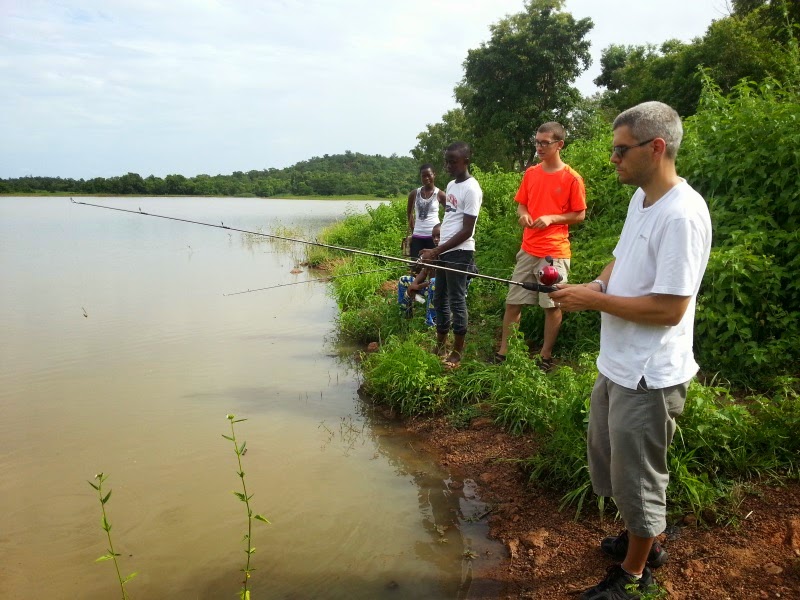
Two weeks ago we went on our first trip outside of town, in the bush (‘La Brousse’). There were six of us on three motorbikes: Quentin (the American student missionary), Christian (our neighbour), couple of Christian’s friends and us. We took the main road going west of Kandi for about 10km. For a change, we wore motorbike helmets – this was a long ride after all! When we left the main road and turned onto the dust track leading to the fishing site, the bikes immediately began to slide on account of the recent rain which had turned the track into a bit of a mud bath. They became really hard to control, especially for a beginner like me (Etienne). With a little persuasion, we convinced Christian to take the wise decision of parking the three motorbikes under a massive mango tree by the main road and covering the remaining 3km on foot. After a few minutes, we found ourselves among cotton and maize fields. We spotted some beautiful birds which we had never seen before – bright red and yellow. I promised myself that I would come back with my camera one day to take pictures. After 35 minutes of walking, we had to cross a stream of water which was about 15 metres wide (in which some locals were bathing themselves and washing clothes). We were advised not to go barefoot, so our hiking shoes and thick socks got soaked and remained that way for the rest of the day! After crossing the stream, we climbed up a little bank and arrived at the dam where we ate our lunch. It wasn’t a particularly relaxing experience for me as Quentin informed us that there were some crocodiles residing in the lake but thankfully we didn’t meet them on this trip! After lunch, we spent about an hour and a half fishing in the lake. Carolyn caught the biggest fish of the day (and I am not referring to myself ;-)) – it was actually only a few inches long but Quentin told us the missionary kids would enjoy eating it as a post-dinner snack. We then headed back home to rest a little bit before evening prayer. We were thankful the weather was overcast, as we could easily have got sun-burned. As it was, we ended up with some nice tan lines from this expedition :-)

(See pictures below)

************************************************************************

Il y a deux semaines nous sommes sortis de la ville pour aller dans la brousse. Nous étions six sur trois motos : Quentin, l’étudiant missionnaire, Christian, notre voisin, un couple ami de Christian et nous. Nous avons suivi la route principale de Kandi en direction de l’ouest sur environ 10 km. Pour une fois nous avions des casques - après tout c’est un long voyage ! Lorsque nous avons quitté la route principale pour nous engager sur un chemin poussiéreux qui mène au lieu de pêche, les motos se sont mises à déraper à cause des récentes pluies qui avaient transformé le chemin  en une véritable patinoire  de boue. Elles devenaient vraiment difficiles à contrôler, particulièrement pour moi, Etienne, pilote novice. Usant de persuasion, nous avons convaincu Christian de prendre la sage décision de garer nos trois motos sous un manguier imposant au bord de la route principale et de parcourir à pieds les trois Km restants. Quelques minutes plus tard nous étions au milieu des champs de maïs et de coton. Nous avons découvert  de magnifiques oiseaux que je n’avais jamais vus auparavant : rouges vifs et jaunes. Je me suis promis de revenir une fois  avec mon appareil photos. Après 35 minutes de marche, nous avons dû traverser un cours d’eau de 15 mètres de large, dans lequel des gens du pays se baignaient ou lavaient leurs vêtements. On nous avait conseillé de ne pas venir pieds nus, alors nos chaussures de marche et nos grosses chaussettes ont été trempées et le sont restées toute la journée ; Après avoir franchi cet obstacle, nous avons franchi un petit talus et sommes arrivés à un barrage où nous avons déjeuné. Ce ne fut pas pour moi une expérience tout à fait relaxante, car  Quentin nous avait dit qu’il y avait quelques crocodiles dans le lac, mais nous ne les avons pas vus lors de cette balade. Après notre lunch, nous avons pêché pendant une heure et demie. Carolyn a attrapé le plus gros poisson de la journée (je ne fais pas référence à moi, Etienne), il ne mesurait toutefois que quelques centimètres, mais Quentin nous a assurés que les enfants du pasteur les apprécieraient comme collation après le souper. Nous sommes ensuite retournés à la maison pour nous reposer un peu avant la prière du soir. Nous étions reconnaissants que le ciel ait été couvert, nous aurions pu être brûlés par le soleil, puisque même dans ces conditions nous avons bien bronzé.


Back to Cotonou ! / De nouveau à Cotonou!

On Sunday 14 September, we travelled back to Cotonou (in the south) with one main purpose: to complete the application for the ‘Carte de Sejour’ (Residency Card), which involved gathering a lot of documents from several different places. Before getting into the details of the application process, we want to thank God because the 12-hour bus journey wasn’t as scary and crazy as the one we took three weeks ago! This is possibly due to the fact that the roads were in a worse condition after the torrential rain that had fallen over the previous few days so the bus had to go slower and, in addition, the coach was less powerful. (It was also lacking air-conditioning, but we were just grateful to be feeling fairly safe!) Arriving in Cotonou, Quentin showed us to our accommodation. For this trip, we went to a centre run by the UEEB (Union Eglise Evangelique du Benin – Benin Union of Evangelistic Churches), which offers cheap accommodation to missionaries (£4 per person per night). The least we can say is that it was peaceful. During the week we stayed there, we only saw one other person staying there (besides Quentin and, later on, Michee) so it wasn’t really a problem that the shower and toilets were shared between the rooms.
Our week was mostly spent on the road, going from one administrative building to another. I checked our expenses report and we used 33 zemidjans (moto-taxis) each while we were there. This means 66 different drivers, 66 different bikes and 66 different experiences. Some of the bikes were missing a wing mirror, some drivers were very aggressive on the accelerator and brake, some were quite happy to drive at night with their headlights switched off (probably to extend the life of the light bulbs), some weren’t very good at staying together and ended up getting lost (I, Etienne, seemed to have a special gift for choosing the navigationally-challenged drivers and Carolyn and Quentin ended up waiting for me on several occasions, sometimes for up to 10 minutes). Anyway, throughout the week, we went to the French Consulate three times, the Benin Immigration Office four times, the Benin Adventist Mission three times, the Ministry for Foreign Affairs three times, the Police Hospital twice, the airport twice and the State Treasury twice. Some of the processes we faced were pretty ridiculous and frustrating. To give you an example, here’s what we had to do at the Police Hospital to get an official medical certificate. First, we had to pay for the entire process using a cashier outside the building. Then we went inside and upstairs to Secretariat and (when the lady finally turned up for work about 30 minutes late) the secretary checked our passports and told us to go down the corridor to the laboratory. We waited there for a bit, then had blood samples taken, after which we were sent back to Secretariat. The secretary then wrote down our blood sample numbers, stapled two papers together and told us to come back in two days’ time at 3pm for our results. When we came back two days later, there were about 15 people waiting already. We went to the laboratory to pick up our envelopes with the results, then waited with the others to see the secretary. When it was our turn, we took our results to the secretary and left them with her as well as our passports, then waited outside again. After 30 minutes, the secretary emerged with arms full of paper and told us and about 20 other people to follow her downstairs and wait to be called by the doctor there. The doctor then called people into his office one by one, took our passports, signed our medical certificates (blood test results) and wrote some notes in a book, then sent us all back to the secretary (but he kept hold of the passports). So we went back upstairs to the secretary, waited some more, then entered the office where the secretary wrote slightly different notes in a book and asked us to sign them before sending us back downstairs to pick up our passports from the doctor. It was such a relief to finally leave that building!
We were hoping to complete the application process on Thursday afternoon so we could travel back to Kandi on Friday, but as the sun set on Thursday, we were still missing two documents. Consequently, we took the decision to extend our trip a bit, praying that all the documents would be with us by Friday. At 11am on Friday, we received the last document and could finally make our way to the immigration office. Thankfully, it went very smoothly over there so all our hard work paid off, and when we return to Cotonou in November to renew our visas, our cartes de sejour should be ready, meaning that we will be able to get visas covering the rest of our time in Benin (rather than just 3 month visas).
While we were in Cotonou, on Tuesday night, we welcomed Michee Bade, our Career Missionary, back to Benin. As we will work with him all year long, it was exciting to finally spend more time with him. We also took a trip to the airport on Wednesday night as it was time for Quentin to depart and fly back to the USA. We were sad to see him leave as he has been such a blessing and a great mentor to us. As his time here has come to an end, it is now our time to take every opportunity to learn from the people here and make an impact in Kandi.
See Photos below:
1. Rush hour in Porto Novo, on our way to Cotonou.
2. Beninois scaffolding on a building opposite the UEEB centre - I wouldn't dare climb it!
3. Quentin leaving the UEEB for the last time. The guys in yellow are the zemidgan drivers.

*********************************************************************************

Le dimanche 14 septembre nous sommes retournés à Cotonou avec comme objectif de finaliser les démarches pour l’obtention de la carte de séjour, ce qui nécessite de rassembler de nombreux documents administratifs. Avant de partager les détails de ce processus, nous voulons remercier Dieu car les 12 heures de voyage n’ont pas été aussi effrayantes et folles que lors du précédent voyage il y a trois semaines. Cela est peut-être du au fait que les routes étaient dans un état pire à cause des pluies torrentielles des derniers jours. Le bus a donc roulé moins vite, et de plus c’était un modèle moins puissant. (Il n’y avait pas de clim, mais on s’est senti beaucoup plus en sécurité). A notre arrivée à Cotonou, Quentin nous a conduits à notre hébergement, le centre de l’Union des Eglises Evangéliques du Benin, qui propose des chambres à bas prix (4 $ par nuit et par personne) pour les missionnaires. Le lieu est paisible. Pendant toute la semaine, nous n’avons croisé qu’une seule personne à l’exception de Quentin qui était avec nous, puis de Michée, ce qui a facilité le partage de la douche et des WC.
Notre semaine a consisté essentiellement à passer d’une administration à une autre. Selon le relevé de nos dépenses nous avons utilisé 33 « zemidjan" (moto-taxis) chacun, ce qui signifie 66 motos différentes, 66 pilotes différents, et 66 expériences particulières. Certaines motos n’avaient pas de rétroviseur, certains conducteurs étaient très brutaux à l’accélération ou au freinage, d’autres se faisaient un plaisir de rouler de nuit sans phare, vraisemblablement pour économiser l’ampoule, d’autres n’étaient pas capables de rester en groupe et finissaient par se perdre. Il semble qu’Etienne ait le don de choisir des pilotes qui n’ont pas le sens de l’orientation, et Carolyn et Quentin ont souvent du l’attendre, parfois presque 10 minutes. En fait au cours de cette semaine nous nous sommes rendus 3 fois au Consulat de France, 4 fois au Bureau de l’Immigration du Bénin, 3 fois dans les locaux de la Mission Adventiste, 3 fois au Ministère des Affaires Etrangères, à l’Hôpital de la Police trois fois aussi, et deux fois à l’aéroport et au Ministère des Finances. Certaines de ces démarches  nous ont paru ridicules et frustrantes. Comme illustration, voici par où nous sommes passés à l’hôpital de la police pour avoir un certificat médical officiel : d’abord il a fallu payer le coût de la procédure auprès d’un caissier à l’extérieur du bâtiment, ensuite monter au secrétariat  et  attendre 30 minutes que la secrétaire veuille bien se mettre au travail, puis elle a contrôlé nos passeports et nous a dit de descendre au laboratoire. Nous avons attendu encore un peu avant la prise de sang,  puis sommes revenus au secrétariat. La secrétaire a relevé les numéros de notre prise de sang, a agrafé deux papiers ensemble et nous a dit de revenir dans deux jours, à 15 heures pour chercher les résultats. Lorsque nous sommes revenus, deux jours plus tard, il y avait déjà une quinzaine de personnes qui attendaient. Nous sommes passé au laboratoire prendre deux enveloppes avec  nos résultats, puis avons attendu avec les autres de pouvoir rencontrer la secrétaire. Lorsque ce fut notre tour, nous lui avons présenté les résultats qu’elle a gardés ainsi que nos passeports et avons dû encore attendre. Au bout de trente minutes, elle est sortie de son bureau, les bras chargés de dossiers et a demandé à tout le monde de la suivre en bas et  d’attendre d’être appelé individuellement dans le bureau du médecin.  Celui-ci nous a fait entrer un par un, a pris nos passeports, a signé notre certificat médical  (les résultats d’analyse sanguine) a griffonné quelque chose dans un registre et nous a ensuite renvoyés tous ensemble auprès de la secrétaire. Nous sommes donc remontés à l’étage, avons encore attendu, puis sommes entrés dans son bureau  pour qu’elle note dans un registre d’autres informations que nous avons dû signer, avant de retourner vers le médecin pour récupérer nos passeports. C’est avec un profond soulagement que nous avons quitté cet endroit ! 
Nous espérions achever toutes nos démarches le jeudi après-midi pour pouvoir rentrer à Kandi le vendredi, mais à la fin de la journée, il nous manquait encore deux documents. Nous avons donc choisi de rester plus longtemps dans l’espoir de pouvoir obtenir ces documents le lendemain. Vendredi à 11 heures nous recevions le dernier document administratif. Nous pouvions donc nous rendre à l’Office de l’immigration. Là, les démarches ont été paisibles, l’agitation des jours précédents fut récompensée, et lorsqu’en novembre nous retournerons à Cotonou pour renouveler notre visa, nos cartes de séjour devraient être prêtes ce qui nous permettra d’avoir un visa pour le reste du séjour au Bénin.
Pendant notre séjour à Cotonou, le mardi soir nous avons accueilli Michée Badé, de retour au Bénin. Comme nous allons travailler avec lui toute l’année, c’était une joie de pouvoir passer plus de temps avec lui. Nous avons aussi accompagné Quentin à l’aéroport le mercredi soir pour son retour aux Etats Unis.  Nous étions tristes de le voir partir car il a été pour nous une source de bénédictions et un excellent mentor. Son temps ici s’achève, et il nous faut maintenant  saisir toutes les opportunités pour apprendre des autochtones et être efficaces à Kandi.
Photos:
1. Heure de pointe à Porto Novo, sur la route pour Cotonou.
2. Des échafaudages béninois, sur lesquels je n’oserais pas grimper, en face du bâtiment de L’Union des Eglises Evangéliques 
3. Quentin pour la dernière fois devant le bâtiment de L’Union des Eglises Evangéliques. En jaune, les pilotes des zemidgan.

Quentin's last Sabbath / Le dernier Sabbat de Quentin

Saturday 13 September was Quentin’s last Sabbath in Kandi, so many of us gathered together at church to listen to his last sermon and send him off with love. Carolyn was in charge of coordinating a 30-minute celebration service between Sabbath School and the worship service. She had organised for about a dozen church members and friends of Quentin to share a thought, a message of appreciation, a song or a gift with Quentin. What was shared by everyone was very touching and it was obvious how much he is loved by the people here. For us, Quentin is a great inspiration and an excellent example to follow. We feel blessed to have been able to witness this occasion and share this experience with him. At the end of the worship service, we took the opportunity to take plenty of photos. As you can see, Quentin decided that all the missionaries in Kandi should have matching African outfits for the occasion. :-) It was a very uplifting Sabbath, and there is no doubt that Quentin will be missed greatly (not just by us!).

(see picture below) 
***********************************************************************

Le sabbat 13 septembre fut le dernier sabbat de Quentin à Kandi. Nous nous sommes réunis nombreux à l’église pour écouter son dernier sermon et le laisser partir assuré de toute notre affection. Carolyn avait la responsabilité d’animer un temps spécifique pour cela entre l’école du sabbat et le culte. Elle a demandé à une douzaine de membres d’église et d’amis de Quentin d’exprimer leur reconnaissance par quelques mots, un message, un chant ou un cadeau. Ce que chacun a exprimé fut touchant et montre combien il a été aimé par les gens d’ici. Pour nous il a été une source d’inspiration et un excellent exemple à suivre. Nous nous sentons privilégiés d’avoir pu participer à ses adieux. A la fin du culte, nous avons pris de nombreuses photos ; Comme vous pouvez le voir, Quentin avait décidé que pour la circonstance tous les missionnaires à Kandi devaient revêtir la même tenue africaine. Ce fut un sabbat  bienfaisant, et II est sûr que Quentin va manquer à beaucoup. (Et pas seulement à nous)

Tuesday, 23 September 2014

Taking nothing for granted / Ne rien considérer comme acquis

We would like to share with you just a few things that are taken for granted in our European culture, but cannot be taken for granted over here in Benin.

Back home, every single time we plug in an electronic appliance, we expect it to work or start charging. That is not the case here. We have at least one power cut a day. At the moment it is the rainy season, so supposedly it is not too bad. But during the dry season we’ve been told that power cuts can last as long as three days. Obviously, we never know in advance when the power cuts will occur and how long they will last. This can make things tricky, especially with mobile phones for example. If there’s a power cut when the phone runs out of battery, we never know when we’ll be able to charge it again. But the worst thing for us is when a power cut occurs during nap time in the heat of the day at around 2pm - immediately the ceiling fan winds down and ceases to work. Then we have no choice other than sweating.

It’s a similar story for the water. Sometimes we use the toilet and go to flush it, only to find that nothing happens as the water supply has been cut. Of course, we are then unable to wash our hands under running water at the sink. It’s not great. Luckily enough, water cuts are never as long as power cuts. (For you hygiene freaks out there, we always have two buckets filled with water in the bathroom so we can wash our hands… or finish showering if the water stops during a shower!) On the subject of water, there is just one water temperature and it’s the same for everyone. I guess we could call it ‘pipe temperature’ but the word ‘cold’ is probably more descriptive! Anyway, we’re still blessed to live in the apartment we’re in. Recently we visited a church member who doesn’t have electricity or running water. He gets all his water from a well (for showering, drinking and cooking) and his head torch is the only electrical device he can use.

Regarding food, we are used to having a whole variety of fruit and veg all year round at the supermarkets. Here, there are no supermarkets. And at the market in Kandi, the only vegetable we’ve seen is okra. Apparently there is one lady who sometimes brings vegetables to sell but she only comes to market for about six months of the year and of course her produce is very expensive. The only fruits we’ve seen so far are bananas (ripe but with green skins) and oranges (not quite ripe and with yellow skins). We are definitely missing the variety of fruit and veg that we had back home. We are really looking forward to April when the mango season begins!

The internet connection here is a lot worse than we were anticipating. It is very expensive and very slow. All internet connections are through mobile phones as we still haven’t seen a landline. 3G technology hasn’t reached Kandi yet although it is slowly spreading through Benin. The concept of unlimited data non-existent here! We have to buy internet credit every month. The maximum that we can buy is 3GB per month and that costs around $30 so we are trying to stick to 250 MB per month, which costs around $4. That’s why the pictures we are sharing with you on this blog or in the newsletter are small and not the greatest quality (and also the reason for asking you not to send us photos, videos or powerpoint presentations by email). Facebook is out of the question!

Among all these new things to get used to, there is one particularly good surprise: the impact of rain on the schedule. To summarise, when it rains, people know that the dust tracks will be muddy and awful to drive on for a few hours so everyone stays at home, i.e. people don’t go to work, the kids don’t go to school and if a meeting had been planned, it is postponed. With all the rain we have had this week, we have had several opportunities to have lie-ins, so this is an extra reason for us to thank God for the rain! Unfortunately, we’ve been told that from mid-October to early June it is very unlikely that we will see any rain. We shall certainly make the most of it while it lasts – living with all these changes is interesting but tiring!

(See pictures below) 

************************************************************************************************

Nous voulons partager avec vous quelques sujets qui dans notre culture européenne sont considérés comme acquis, et ne peuvent être considérés comme tel ici au Benin.

Chez nous, chaque fois que l’on branche un appareil électrique ou électronique à une prise, nous nous attendons à ce qu’il marche ou qu’il commence à charger. Ce n’est pas le cas ici. Nous avons au moins une coupure de courant par jour. Actuellement c’est la saison des pluies, et cela ne semble pas trop grave. Mais on nous a dit qu’à la saison sèche les coupures peuvent durer jusqu’à trois jours. Et de toute évidence, nous ne savons jamais quand elles auront lieu et combien de temps elles dureront. Cela ne facilite pas les choses, notamment avec les téléphones portables. Si la coupure de courant a lieu au moment où la batterie est plate, nous ne pouvons savoir quand nous pourrons la recharger. Mais le pire c’est quand la panne a lieu pendant la sieste, en pleine chaleur, vers 14 heures, car le ventilateur du plafond s’arrête, et nous n’avons d’autre choix que de transpirer à grosses gouttes. 

C’est la même histoire avec l’eau. Il nous arrive d’aller au WC, de tirer la chasse pour constater que rien ne se passe, l’alimentation en eau étant interrompue. Et bien sûr, nous ne pouvons-nous laver les mains à l’eau courante de l’évier. Ce n’est pas génial ! Heureusement ces coupures ne durent jamais aussi longtemps que les coupures de courant (pour ceux que les questions d’hygiène obsèdent, nous avons toujours deux seaux remplis d’eau qui nous permettent de nous laver les mains ou d’achever notre douche si jamais l’eau s’interrompt au mauvais moment!). L’eau n’a qu’une température, la même pour tous. Je pense que nous pourrions dire qu’il s’agit de la température des tuyaux, mais froide est probablement le mot qui la décrit le mieux. Peu importe, nous sommes reconnaissants de vivre dans l’appartement où nous vivons. Il y a peu, nous avons rendu visite à un membre d’église qui n’a ni électricité, ni eau courante. Toute l’eau dont il a besoin pour se doucher, pour boire et cuisiner, il va la puiser. Sa lampe de poche frontale est la seule chose qui fonctionne à l’électricité (de batteries AA).

Pour ce qui est de la nourriture, nous sommes habitués à avoir toute l’année dans nous supermarchés une variété des fruits et légumes. Ici, il n’y en a pas. Au marché de Kandi, le seul légume que nous avons vu est le gombo. Il semble qu’il y ait une femme qui parfois vienne vendre des légumes, mais elle ne vient que pendant six mois dans l’année et naturellement ses produits sont très chers. Les seuls fruits que nous ayons vus sont des bananes mûres avec une peau verte, et des oranges pas tout à fait mûres avec une peau jaune. La variété des fruits et légumes que nous avions à la maison nous manque, et nous attendons impatiemment le mois d’avril, lorsque commencera la saison des mangues.

Les connections internet sont bien pires que ce que nous avions imaginé. Très chères et très lentes. Toutes les connections passent par les téléphones portables et nous n’avons pas encore vu de ligne de téléphone fixe. La technologie 3G n’est pas encore parvenue jusqu’à Kandi, bien qu’elle commence lentement à se répandre au Bénin. Le concept d’accès illimité à des sources de donnée est inconnu ici. Nous devons acheter un crédit internet chaque mois, de 3 gigas au maximum et cela coute près de 30 dollars. Nous essayons donc de nous limiter à 250 mégas par mois ce qui nous coûte 4 dollars. C’est pour cela que les photos que nous partageons avec vous sur le blog ou dans la newsletter sont petites et pas de la meilleure qualité, et c’est aussi la raison pour laquelle nous vous demandons de ne pas nous envoyer de photos, de vidéos ou de PowerPoint avec vos emails. Quant à Facebook, on n’en parle même pas !

Au milieu de toutes ces nouveautés auxquelles il faut nous habituer, il y en a une qui est une bonne surprise : l’effet de la pluie sur l’emploi du temps. En résumé, quand il pleut, les gens savent que les chemins poussiéreux deviennent boueux et impraticables pendant quelques heures, alors tout le monde reste chez soi, c’est-à-dire que personne ne va travailler, que les enfants ne vont pas à l’école et que si une rencontre est programmée elle est repoussée. Avec toutes les pluies tombées cette semaine, nous avons eu ainsi plusieurs opportunités de nous reposer, et c’est une raison supplémentaire de remercier Dieu pour la pluie. 

Malheureusement, on nous a dit que de la mi-Octobre jusqu’au début Juin il est peu probable que nous revoyons la pluie. Nous allons donc profiter de cette situation aussi longtemps que cela dure. Vivre tous ces changements est intéressant, mais fatiguant.

Wednesday, 10 September 2014

Our new home! / Notre nouvelle demeure!

At the moment, we are living in the apartment that was rented for Quentin, the student missionary who is heading back to the US next week. We could easily get used to living here! It is a first-floor apartment, which is very rare in Kandi, and it has three rooms: an L-shaped living room/dining room, a bedroom and a bathroom. As you have probably noticed, there is no kitchen. This is quite common here as most people cook outside, either in their courtyard or in the street. At the moment, we eat every meal with the Badé family, who live 30 meters away, so we haven’t really done any cooking. The apartment is furnished, which is also very unusual for Kandi, so we have one sofa, two arm chairs, a dining table with five chairs, a bookshelf and a cabinet. In our bedroom, we have a very large bed (Carolyn is happy), one bedside table and a triple wardrobe. Quentin kindly set up a mosquito net above the bed the day before we arrived (he is currently staying in the guest bedroom at the Badé home). In the bathroom, we have a flushing toilet, a sink and a showerhead. It is essentially a wet room as there is no screen or curtain for the shower – when we have showers, everything gets wet! Like everywhere else in Benin, there is only cold water and the water cuts are regular so we always have two big buckets full of water before we start showering.
The pictures below (after French version) will give you a better idea of what our apartment is like…

************************************************************************************************

Pour l’instant nous vivons dans l’appartement qui a été loué pour Quentin, l’étudiant missionnaire qui doit repartir aux Etats Unis la semaine prochaine. Nous nous sommes facilement habitués à vivre dans cet appartement de trois pièces au premier étage, ce qui est très rare à Kandi : un salon-salle à manger en L, une chambre à coucher et une salle de bain. Comme vous l’avez vraisemblablement noté, il n’y a pas de cuisine. C’est tout à fait habituel ici, car la plupart des gens cuisinent à l’extérieur, soit dans la cour de leur maison, soit dans la rue. Pour l’instant nous prenons tous nos repas avec la famille Bade, qui habite trente mètres plus loin. Nous n’avons donc pratiquement pas cuisiné. L’appartement est meublé, ce qui est aussi inhabituel: un canapé, deux fauteuils une table pour manger avec 5 chaises, une bibliothèque et un cabinet. Dans la chambre à coucher, un grand lit – ce qui rend Carolyn heureuse - une table de nuit et une garde-robe à trois portes. Quentin a aimablement installé une moustiquaire au-dessus du lit juste avant que nous n’arrivions, et il loge actuellement dans la chambre d’amis des Bade. Dans la salle de bain, un WC avec chasse d’eau, une douche et un lavabo. C’est une chambre très humide car il n’y a pas de rideau et quand on se douche, on mouille tout. 

Les images ci-dessous vous donneront une meilleure idée de ce à quoi ressemble notre appartement.